
FXIFY drawdown rules differ by program — the One Phase and Two Phase Standard models use a trailing drawdown that locks at your starting balance once you profit enough, while the Two Phase Classic, Three Phase, and Two Phase Pro models use a static drawdown fixed from day one. Knowing which type you’re trading under is the single most important rule you must understand before you place your first trade.
FXIFY Drawdown Rules Explained: Static vs Trailing

If you’ve ever had a funded account blown not by bad trading but by a rule you misunderstood, you already know the answer. FXIFY drawdown rules exist to protect the firm’s capital and to ensure that only disciplined, risk-aware traders manage real money. But “drawdown” isn’t a single concept at FXIFY. It comes in two distinct forms, static and trailing, and each one behaves differently under live trading conditions.
Getting this wrong is one of the leading reasons traders fail FXIFY challenges despite being profitable. A trader can close the day with a green P&L and still breach a trailing drawdown rule because of how floating equity peaks are calculated. Understanding the precise mechanics of FXIFY drawdown rules for each program is therefore not optional, it’s the foundation of your challenge strategy.
This guide breaks down both drawdown types, maps them to every active FXIFY program as of 2026, works through real numerical examples, and shows you how to adapt your trading style to each model.
The Two Types of Drawdown at FXIFY
Static Drawdown: A Fixed Floor That Never Moves
Static drawdown sets a permanent minimum equity level based on your starting account balance. No matter how much profit you accumulate, that floor does not rise. It stays anchored to the day you opened the account.
Example:
- Account size: $100,000
- Static drawdown limit: 10%
- Drawdown floor = $90,000 – forever
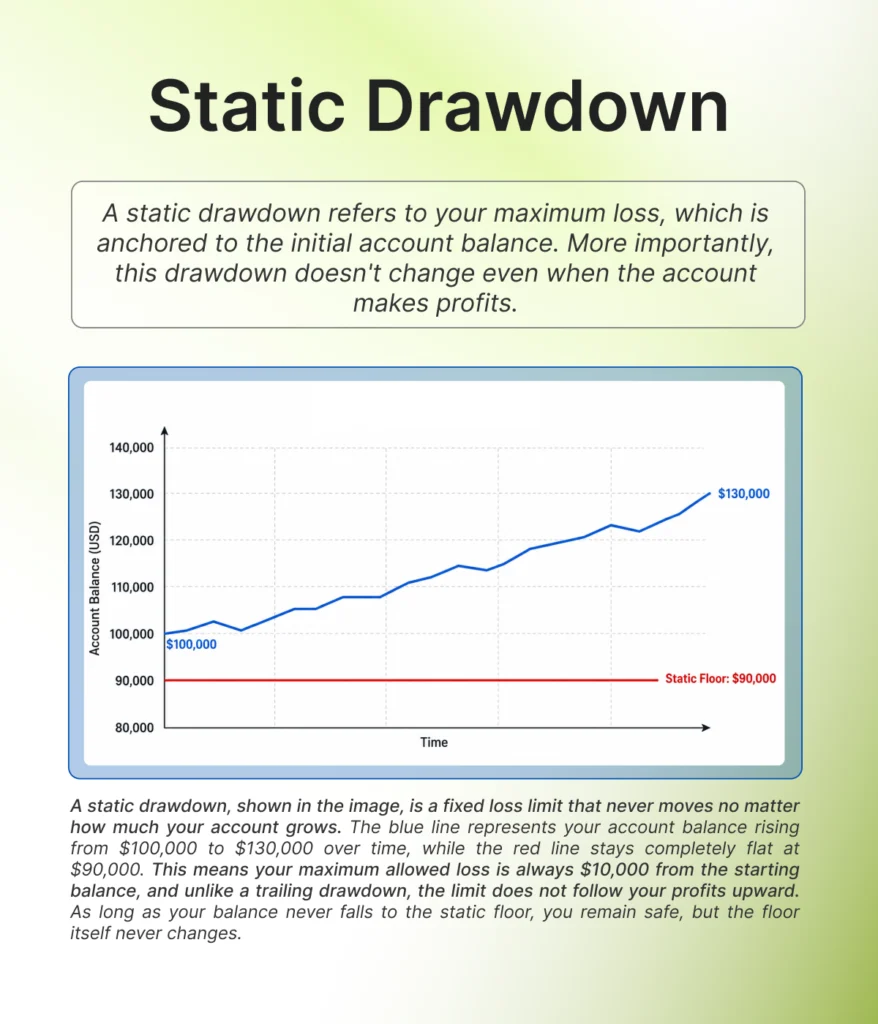
If your account grows to $130,000 over several weeks of excellent trading, your floor is still $90,000. You now have $40,000 of breathing room. This is the key advantage of static drawdown: profits expand your cushion rather than tightening your risk.
This model suits swing traders and position traders who hold trades for days or weeks. The larger equity buffer means short-term volatility is less likely to wipe out your account.
Trailing Drawdown: A Floor That Follows Your Profits
Trailing drawdown moves upward in lock-step with your account’s highest recorded balance, what the industry calls the High Water Mark (HWM). Every time your account hits a new equity peak, the drawdown floor ratchets up by the same amount. Profits increase your floor, which simultaneously reduces your risk buffer.
Example:
- Account size: $100,000
- Trailing drawdown limit: 6%
- Opening floor = $94,000
- You trade up to $103,000 → floor moves to $97,000
- You trade up to $106,000 → floor moves to $100,000 (break-even lock, see below)
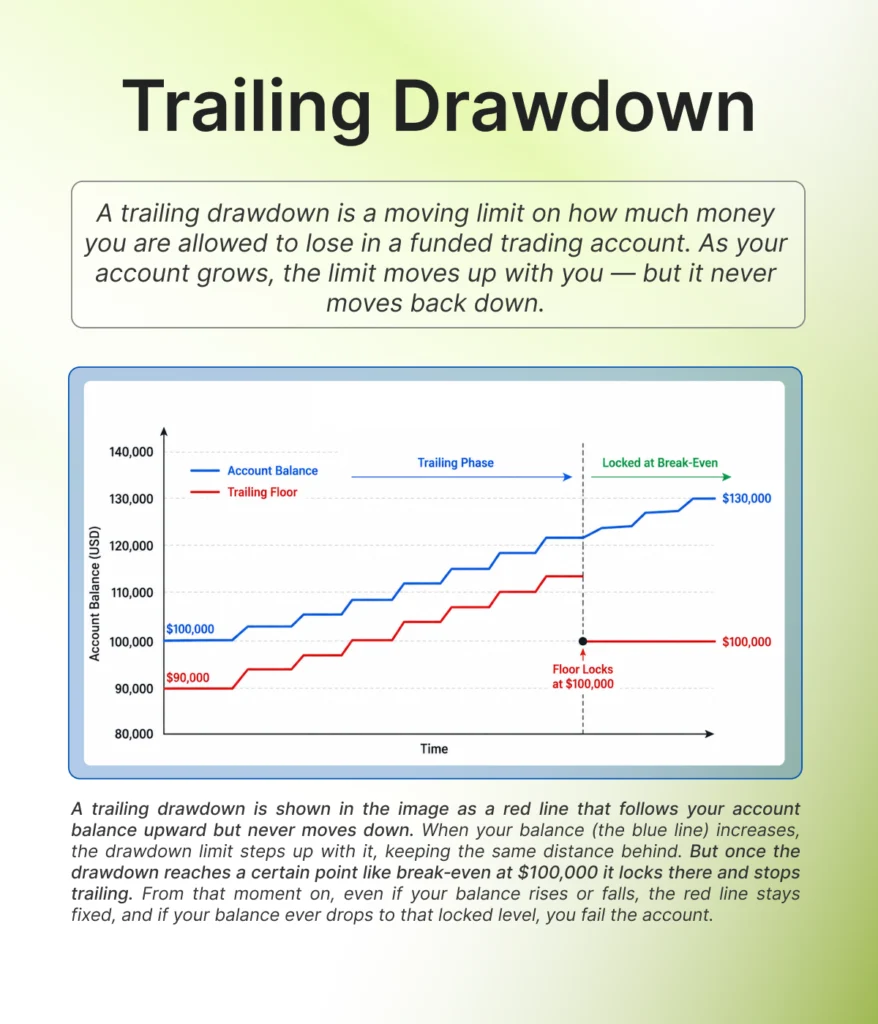
Once your floor reaches your starting balance, FXIFY’s trailing drawdown locks at that level and stops trailing. This is a critical and trader-friendly feature specific to FXIFY’s One Phase and Two Phase Standard models, confirmed by FXIFY
The Break-Even Lock: FXIFY’s Most Misunderstood Feature
According to FXIFY, for the 1-phase program, the max trailing drawdown is set at 6% of your starting balance. This 6% trails your high water mark, calculated on your closed balance, not floating equity, until you reach 6% profits in your account. Once you have achieved 6% in profits, the maximum trailing drawdown locks in at your starting balance and no longer trails.
On a $100,000 One Phase account, that means:
- Opening floor: $94,000
- As you close profitable trades, the floor rises toward $100,000
- Once your closed balance hits $106,000 (6% profit), the floor locks at $100,000
- From that point forward, your drawdown behaves effectively like a static rule anchored at your starting balance
This lock is significant. It means that after you’ve secured 6% closed profit on a One Phase account, you can never lose all of your initial capital in one bad session, the floor is permanently cemented at $100,000. For the Two Phase Standard model, the trailing drawdown is 10%, meaning the floor locks once you’ve accumulated 10% closed profit.
FXIFY’s trailing drawdown is calculated on closed balance (end of day, 5 PM EST), not on live floating equity during the session. This is more forgiving than equity-based trailing used by some competitors, but it does not mean open trades are ignored, a large unrealised drawdown can still push your live equity below the floor at any moment.
FXIFY Drawdown Rules by Program (2026)
Here is a precise breakdown of the FXIFY drawdown rules for every available program:
One Phase Challenge
| Parameter | Value |
|---|---|
| Overall Drawdown Type | Trailing |
| Max Overall Drawdown | 6% |
| Trailing Basis | Closed balance (End of Day, 5 PM EST) |
| Lock Point | Locks at starting balance once 6% profit is closed |
| Max Daily Loss | 5% |
| Daily Loss Basis | Previous day’s 5 PM EST balance |
Best for: Experienced traders who want single-stage access to funding and can build consistent closed profits quickly to trigger the lock.
Two Phase Standard
| Parameter | Value |
|---|---|
| Overall Drawdown Type | Trailing |
| Max Overall Drawdown | 10% |
| Trailing Basis | Closed balance (End of Day, 5 PM EST) |
| Lock Point | Locks at starting balance once 10% profit is closed |
| Max Daily Loss | 4% |
| Profit Targets | Phase 1: 10%, Phase 2: 5% |
Best for: Traders comfortable with a wider trailing buffer who want a two-stage path to funding. The 10% trailing gives significantly more room than the One Phase’s 6%.
Two Phase Classic
| Parameter | Value |
|---|---|
| Overall Drawdown Type | Static |
| Max Overall Drawdown | 10% |
| Drawdown Floor | Fixed at starting balance minus 10% — does not move |
| Max Daily Loss | 4% |
| Profit Targets | Phase 1: 10%, Phase 2: 5% |
| Consistency Rule | 25% (funded stage) |
Best for: Swing traders and traders who accumulate profits early and want a fixed, predictable floor that grows more forgiving with every profitable trade.
Three Phase
| Parameter | Value |
|---|---|
| Overall Drawdown Type | Static |
| Max Overall Drawdown | Varies by account size (typically 6–8%) |
| Max Daily Loss | 3–5% |
| Profit Targets | 10% / 5% / 5% across three stages |
Best for: Methodical traders who prefer the most conservative evaluation path and want a static floor from day one across all three phases.
Two Phase Pro
| Parameter | Value |
|---|---|
| Overall Drawdown Type | Static |
| Max Overall Drawdown | Static from starting balance |
| Note | Performance Protect add-on not available on this model |
Instant Funding
| Parameter | Value |
|---|---|
| Overall Drawdown Type | Trailing |
| Max Overall Drawdown | 8% |
| Max Daily Loss | 8% |
| Lock Mechanic | Trailing locks at starting balance |
| Note | After withdrawal, drawdown locks at starting balance regardless of profits |
The Instant Funding program carries a specific post-withdrawal risk: according to FXIFY’s official support documentation, when you request a withdrawal, the Max Drawdown locks at your starting balance regardless of profits made. This means the buffer created by your profits is reduced by the amount withdrawn. Withdrawing all available profit would put your account at risk of breaching the drawdown thresholds.
Lightning Challenge
| Parameter | Value |
|---|---|
| Overall Drawdown Type | Trailing |
| Max Overall Drawdown | 4% |
| Max Daily Loss | 4% |
| Profit Target | 5% |
| Consistency Rule | 30% |
| EAs | Not permitted |
The Lightning program’s 4% trailing drawdown is the tightest across all FXIFY programs, designed for fast-execution traders who can reach the target in a concentrated window of trading days.
How FXIFY Calculates Your Daily Loss Limit
Daily loss limits across all FXIFY programs are calculated based on your balance at 5 PM EST the previous day, not your starting balance and not your current floating equity. This is a critical detail for any trader who holds positions overnight.
If your balance at 5 PM EST on Monday was $102,000 and your daily loss limit is 4%, you can lose up to $4,080 on Tuesday before triggering a breach, not $4,000 based on your original starting capital. Importantly, this means:
- A profitable prior day increases your maximum allowable loss the following day
- A losing prior day decreases it
- The daily reset at 5 PM EST is the clock all risk management should be built around
Static vs Trailing: A Side-by-Side Comparison
| Feature | Static Drawdown | Trailing Drawdown |
|---|---|---|
| Floor movement | Never moves | Rises with profits |
| Calculated from | Starting balance | Highest closed balance (HWM) |
| Profit effect | Increases your buffer | Tightens your buffer (until locked) |
| Best strategy fit | Swing / position trading | Day trading / scalping |
| Programs at FXIFY | 2-Phase Classic, 3-Phase, 2-Phase Pro | 1-Phase, 2-Phase Standard, Instant, Lightning |
| Lock mechanism | N/A | Locks at starting balance after threshold |
How to Trade Around Each Drawdown Type
Trading FXIFY’s Static Drawdown Programs
The static drawdown model rewards patience and early performance. Because your floor never rises, every profitable trade creates more breathing room. Practical strategies:
Front-load your profits. In the early days of a two-phase classic or three-phase challenge, focus on getting your account above target quickly. The wider the gap between your equity and the fixed floor, the more flexible your risk management becomes for the rest of the challenge.
Swing trading is your advantage. Multi-day and multi-week positions are safer under static drawdown because intraday volatility doesn’t move your floor. A trade that dips temporarily into loss before recovering will not tighten your overall buffer.
Set firm daily loss parameters. Since static drawdown floors never move, a string of bad days can still breach the rule. Track cumulative losses daily and implement a hard stop at around 3% equity drop per day on a 10% static account.
Trading FXIFY’s Trailing Drawdown Programs
Trailing drawdown requires more precise management, especially before the break-even lock triggers. Key principles:
Prioritize closing profits over maximizing floating gains. Since trailing drawdown tracks your closed balance at 5 PM EST, the safest behavior is to close profitable trades before the end of the day rather than holding winners overnight. Unrealized profits that reverse by 5 PM do not lock in any floor protection, but they did expose you to a tighter intraday floor.
Target the lock as your first milestone. On a one-phase account, your single most important goal before pursuing the 10% profit target is to accumulate 6% in closed profits. Once the floor locks at the starting balance, you have eliminated the risk of the floor continuing to rise against you.
Be cautious when close to a new HWM. The riskiest moments under trailing drawdown are immediately after you close at a new high balance. Your floor just ratcheted up. Taking on large risk immediately after a peak means your buffer is at its thinnest.
Manage withdrawals on trailing accounts carefully. On Instant Funding specifically, every withdrawal effectively anchors your floor at the starting balance with a reduced equity buffer. Always ensure there is sufficient equity above your starting balance to absorb a withdrawal without immediately putting the account at breach risk.
Common Mistakes Traders Make With FXIFY Drawdown Rules
Mistake 1: Treating the trailing drawdown as equity-based when it’s balance-based. FXIFY’s One Phase and Two Phase Standard trailing drawdown tracks your closed balance at the end of the trading day, not your floating equity during live sessions. Some competitors use equity-based trailing, which is significantly more punishing. This distinction is worth re-reading before you design your risk strategy.
Mistake 2: Assuming the floor is always calculated from the starting balance. Especially on One Phase accounts, the floor rises with every new high-water mark in your closed balance, until the lock triggers. Traders who check their floor against the original starting capital and ignore HWM updates frequently underestimate how close to breach they are.
Mistake 3: Over-withdrawing on Instant Funding accounts. Withdrawing most or all available profit on an Instant Funding account resets your effective equity cushion to near-zero above the floor. Always leave enough closed profit in the account to cover at least one or two bad trading days.
Mistake 4: Not adjusting strategy when switching programs. A trader who passes a Two Phase Classic (static) and then moves to a One Phase (trailing) must completely rethink their risk model. The drawdown type is program-specific, and strategies built for one type frequently fail under the other.
Does FXIFY Offer Any Safety Net for Drawdown Breaches?
Yes , for eligible programs, FXIFY offers an optional add-on called Performance Protect. This feature allows a trader who has breached a drawdown rule but still has net gains in the account to request a payout of those gains (calculated based on the profit split) despite the breach. It acts as a form of insurance against technical violations on otherwise profitable accounts.
Performance Protect is not available on the Two Phase Pro model. For all other eligible programs, it represents a meaningful risk mitigation layer worth considering when selecting your program and add-ons at purchase.
Choosing the Right FXIFY Program Based on Drawdown Type
The most important variable in choosing your FXIFY program isn’t the profit target or the fee, it’s the drawdown model. Here’s a simple framework:
Choose a static drawdown program (Two Phase Classic, Three Phase) if:
- You trade swing or positional strategies with multi-day holds
- You want a predictable, non-moving floor from day one
- You make large profits early and want that buffer to compound
- You can comfortably meet a 25% consistency rule in the funded stage
Choose a trailing drawdown program (One Phase, Two Phase Standard) if:
- You are a day trader or scalper who closes positions before end of the day.
- You want faster access to funding with fewer evaluation stages
- You can consistently hit the lock threshold (6% or 10%) early in the challenge
- You actively track your closed balance HWM as part of your daily routine
For a broader look at how all of FXIFY’s programs compare across fees, profit splits, scaling, and payout timing, read our full FXIFY Prop Trading Company Review.
Conclusion
FXIFY drawdown rules fall into two clearly defined categories: static drawdown, where the floor is anchored at a fixed percentage below your starting balance and never moves, and trailing drawdown, where the floor tracks your highest closed balance until it locks permanently at your starting balance.
Understanding which type applies to your chosen program — and engineering your trading strategy specifically around it — is the single most high-leverage preparation step you can take before beginning any FXIFY challenge. Traders who treat both types identically are the ones who fail accounts they should have passed.
The break-even lock mechanic in FXIFY’s trailing programs is one of the most trader-friendly design choices in the prop firm industry. Reach that lock threshold early and trailing drawdown effectively becomes a static rule, giving you the best of both worlds for the remainder of the challenge.
Frequently Asked Questions About FXIFY Drawdown Rules
FXIFY’s trailing drawdown for the One Phase and Two Phase Standard programs is calculated on the closed balance at 5 PM EST, not on floating equity during the day. However, open trades can push your live equity below the floor at any moment, causing an immediate breach, so unrealised drawdown must still be managed carefully in real time.
Breaching the maximum overall drawdown results in immediate account termination in both challenge and funded phases. There is no grace period or partial breach, the account fails as soon as equity touches or drops below the floor. The only exception is the Performance Protect add-on for eligible accounts with net positive returns.
Yes, FXIFY introduced the ability to select between static (Classic) and trailing (Standard) on the Two Phase challenge at checkout. Selecting Static Drawdown mode targets traders who want a fixed floor and up to 100% profit split, while the Trailing Drawdown mode offers up to 90% profit split with more immediate payout flexibility.
The two rules are independent, both must be respected simultaneously. Breaching either one results in account failure. A trader can be well within their overall drawdown limit but still fail the challenge by losing more than 4–5% in a single calendar day.
Generally, yes. FXIFY maintains the same drawdown type and limit in both the evaluation and funded phases. The rules that govern your challenge are the same rules that govern your live funded account, creating consistent expectations throughout your trading career with the firm.




Reviews, Ratings, Learning and more