
Most traders who buy an FXIFY trading strategy off YouTube or a Discord group fail their challenge within the first two weeks, not because they cannot trade, but because the strategy was never built for FXIFY’s specific rules in the first place.
I have been through FXIFY challenges myself. The 1-Phase with its trailing drawdown. The 3-Phase with its static floor. Developing a proper FXIFY trading strategy for each of those accounts forced me to rethink everything I thought I knew about position sizing and session management. I have felt the difference between a retail account where a bad week is recoverable and a prop firm evaluation where one morning session can close the door permanently. That experience changes how you think about every single trade you place.
What this guide does is give you an honest, rules-first breakdown of the best FXIFY trading strategies in 2026, mapped directly to each challenge type, each drawdown model, and each account size. Whether you have just purchased your first challenge and want to know where to start, or you have been a funded trader for months and are trying to figure out why you keep getting close but not crossing the finish line, this post is written for you.
We cover why generic strategies fail prop firm challenges, how FXIFY’s two drawdown types should completely dictate your approach, the best execution frameworks for both trailing and static accounts, how to handle news trading legally within FXIFY’s rules, EA and copy trading compliance, and the swing-versus-scalping debate settled honestly.
Why Generic Trading Strategies Fail FXIFY Challenges
Here is the uncomfortable truth that nobody selling a “prop firm passing service” wants to say out loud: a strategy that makes you consistent money in a personal retail account can destroy you inside an FXIFY evaluation, not because the strategy is bad, but because the environment operates under entirely different mechanical constraints.
In your own account, a 10% drawdown is painful but survivable. You reload, regroup, and continue. In an FXIFY 1-Phase challenge, that same 10% drawdown ends your account before you have earned a single cent. The rules are not flexible, they are absolute.
There are three specific failure patterns I see repeat constantly among traders who bring the wrong FXIFY trading strategy into their evaluation:
Oversized positions. Retail trading rewards sizing positions large enough to make a meaningful return. FXIFY challenges require you to size positions small enough to survive drawdown without breaching the daily limit. Those are fundamentally different optimisation targets, and traders who do not recalibrate fail fast.
No concept of a daily loss limit. In personal accounts, most traders have no hard stop that ends their session. FXIFY enforces a daily loss limit, typically 4% to 5% depending on your program. A single volatile morning can consume it entirely. Once it is gone, you either stop trading or you breach and lose the account.
Using a strategy mismatched to the drawdown type. This is the biggest and most invisible failure. A swing trader holding positions across three days on a trailing drawdown account is fighting the mechanics of the account itself. A scalper grinding 20 trades per day on a 3-Phase static account is working far harder than necessary. The strategy must match the drawdown model.
The moment I stopped asking “does this strategy make money?” and started asking “does this FXIFY trading strategy survive the account rules?” everything changed.
How FXIFY’s Drawdown Type Should Dictate Your FXIFY Trading Strategy
Before you open a single position, you need to understand which drawdown model your chosen FXIFY account uses, because it is the single most important variable in your entire FXIFY trading strategy selection.
FXIFY currently operates two drawdown models:
Trailing drawdown, used on the 1-Phase, 2-Phase, Instant Funding, and Lightning challenges. Your maximum loss floor follows your equity peak upward. As your account grows, your floor rises with it.
Static drawdown, used on the 3-Phase program. Your maximum loss limit is calculated from your starting balance only and never moves, regardless of how high your equity climbs.
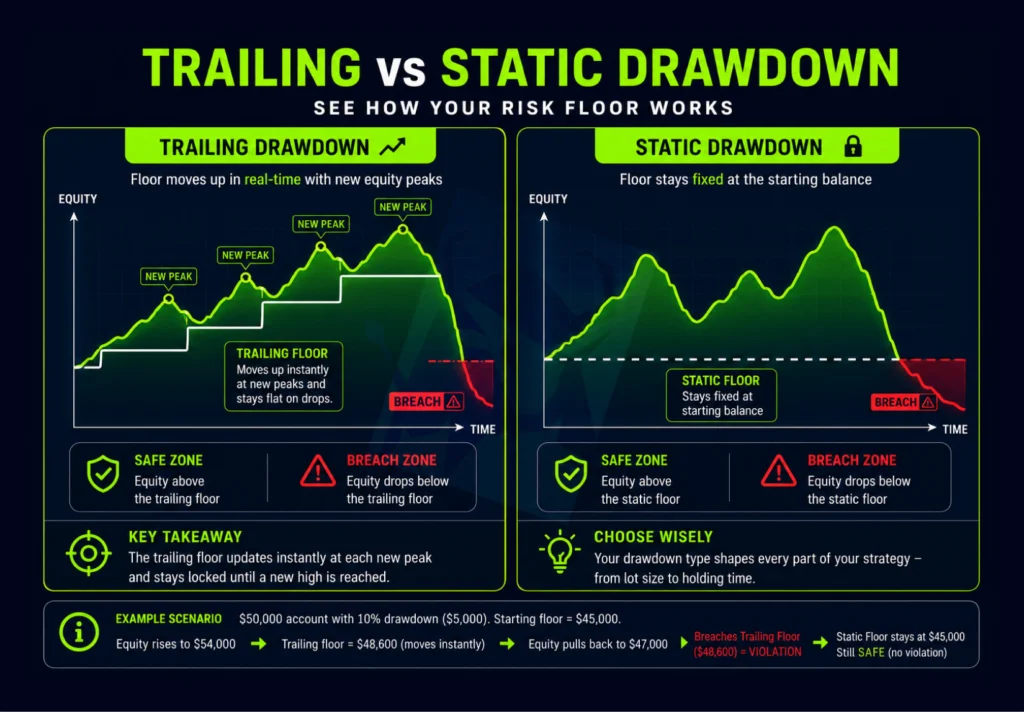
Here is why this matters in raw numbers. Take a $50,000 2-Phase Standard account with a 10% maximum trailing drawdown. Day one, your floor sits at $45,000. You trade well and push the account to $54,000. Now your floor has climbed up to $48,600. You have not created breathing room, you have created a tighter cage. A $5,400 reversion from the peak would breach the account even though you were previously up.
On the 3-Phase static account with the same starting balance and 10% drawdown, your floor is permanently at $45,000. No matter how high the account climbs, that floor never moves. An early profitable run genuinely creates breathing room that stays there.
For a deep technical walkthrough of how FXIFY calculates each drawdown type across programs, see our full FXIFY drawdown rules guide, it includes live worked examples on multiple account sizes.
The practical consequence: Choose your drawdown type before you pick your strategy. Not the other way around. Everything from your lot sizes to your holding periods to your session timing flows from this one decision.
Best Strategies for FXIFY Trailing Drawdown Accounts
If you have chosen the 1-Phase or 2-Phase (the most popular FXIFY challenge paths because of the faster route to funding), you are under trailing drawdown. The four FXIFY trading strategy frameworks below are built specifically for this model, here is how to use them without blowing up.
Strategy 1: Slow Accumulation, The 0.75% Daily Target Method
The goal with trailing drawdown is not to sprint toward the profit target. It is never to give back enough equity to trail the floor dangerously close to your current balance.
Target 0.5% to 0.75% account growth per trading day. This sounds underwhelming. Run the math and it becomes clear why it works. On a $25,000 account at 0.75% daily, you are generating approximately $187 per session. Across 20 trading days, that is $3,750, comfortably above the 10% Phase 1 target of $2,500, with enough buffer to absorb two or three losing sessions without sweating the floor.
This method pairs best with high-probability, lower-reward setups, entries with strong multi-timeframe confluence targeting a 1:1.5 to 1:2 risk-reward rather than swinging for 1:5 or higher. More wins at modest targets mean your equity curve rises steadily. Steady rises mean your trailing floor climbs slowly and predictably. That predictability is what keeps you inside the account.
Strategy 2: Session-Based Intraday Trading
Trailing drawdown accounts reward traders who know when not to be in the market. The London open (08:00–10:00 GMT) and the New York open (13:00–15:00 GMT) produce the highest-probability setups for most major forex pairs. Restrict your active trading to these two windows and close all positions by session close.
The two mechanical benefits are significant. First, you never carry open risk overnight on an account where the floor is chasing your equity peak. Second, your daily loss limit is naturally protected because you stop executing once your target session ends, and a completed session with no open trades cannot trigger an unexpected daily limit breach overnight.
Strategy 3: The Dynamic Buffer Rule
Before opening any trade, calculate your current buffer, the gap between your live equity and your trailing floor. Never risk more than 20% of that buffer on a single trade.
Example: Account currently at $27,500. Your trailing floor sits at $26,000 (based on a $32,000 earlier peak with 10% drawdown). Buffer = $1,500. Maximum risk in this trade = $300.
This dynamic rule automatically reduces your position size when you are under pressure, which is precisely what trailing drawdown accounts require. It prevents the destructive pattern of “I’ll take a bigger trade to make it back quickly”, the most common account-blowing behaviour on trailing drawdown evaluations.
Strategy 4: One Good Trade Per Day (OGT)
Set up your watchlist before the session opens. Define your criteria, structure, trend alignment, entry trigger, and stop-loss. Wait for exactly one setup that satisfies every criterion. Take it. If it wins, you are done for the day. If it loses within your daily limit, you may look for one more.
The OGT method sounds too simple. It works because it removes the grinding, the overtrading, the revenge trades, and the “just one more” positions that quietly erode the buffer between your equity and your trailing floor. On a trailing account, patience is not just a virtue; it is a mechanical requirement.
Best Strategies for FXIFY Static Drawdown Accounts
The 3-Phase FXIFY challenge uses static drawdown. Your floor is fixed at the starting balance from day one and stays there permanently. This changes everything about what is strategically viable.
Strategy 1: Multi-Day Swing Trading
Because the floor does not chase your equity upward, you can allow trades to breathe across multiple sessions without the mechanical penalty that trailing drawdown creates. A setup entered on Monday based on a daily chart structure can be held through Wednesday, and if you are up $800 on Tuesday, that profit does not shrink your available drawdown at all.
The 3-Phase structure makes this even more attractive: each phase requires only a 5% profit target (the lowest of any FXIFY program), and the maximum static drawdown is typically set at 5-10% depending on the specific variant you have chosen. That lower target aligns perfectly with a slower, higher-conviction swing approach.
Important rule: Always use a stop loss. FXIFY does not mandate stops on 3-phase accounts outside of Lightning, but holding a multi-day position without one on any account is how recoverable drawdowns become account-ending ones. Use the full FXIFY review on Forex Trading Journals to understand exactly which rules apply to your specific 3-phase variant before you go live.
Strategy 2: Range Fading in Lower-Volatility Sessions
With no rising floor to worry about, static drawdown accounts accommodate range-bound approaches that trailing accounts handle poorly. The early Asian session (22:00–01:00 GMT) and late US session (19:00–22:00 GMT) tend to be range-bound for major pairs. Identify defined support and resistance on the 1H or 4H chart, and fade the extremes with tight invalidation levels.
The low frequency of this approach, one to three setups per session, also makes the 5% phase target highly achievable without needing to be in the market constantly.
Strategy 3: The Early Gain Recovery Method
Here is where static drawdown genuinely earns its reputation among experienced prop traders: if you take a significant hit in the first week, say the account drops 4%, your floor has not moved. You still have your full remaining drawdown buffer available, and the profit target is still fully achievable.
On a trailing account in the same scenario, your floor may have already crept upward from an earlier profit peak, leaving you with less usable runway than the raw numbers suggest. On static, you simply reassess, tighten your lot sizes for the recovery phase, and continue methodically. This psychological freedom prevents the panic-overtrade response that causes most challenge failures.
Position Sizing Framework for Every FXIFY Account Size
Position sizing is where more FXIFY challenges fail than at any other point, and it is the part of any FXIFY trading strategy that traders consistently underestimate. Traders who understand the market still blow accounts because they size incorrectly for the specific constraints of the program.
The core principle: risk per trade must protect your daily loss limit even if every trade that session loses.
Base Risk Per Trade Table
| Account Size | Daily Loss Limit (5%) | Recommended Risk Per Trade | Max Trades Before Daily Limit Hit |
|---|---|---|---|
| $10,000 | $500 | 0.5–1% ($50–$100) | 5–10 |
| $25,000 | $1,250 | 0.5–1% ($125–$250) | 5–10 |
| $50,000 | $2,500 | 0.5–1% ($250–$500) | 5–10 |
| $100,000 | $5,000 | 0.5% ($500) | 10 |
| $200,000 | $10,000 | 0.25–0.5% ($500–$1,000) | 10–20 |
| $400,000 | $20,000 | 0.25% ($1,000) | 20 |
On accounts above $100,000, reduce the base risk percentage rather than maintaining a fixed figure. Larger funded accounts attract closer monitoring for lot-size consistency. A sudden spike in position size, even on a profitable trade can trigger a compliance review. Keep lots consistent across sessions.
Converting Dollar Risk to Lot Sizes
The calculation is simple:
Lot size = Dollar Risk ÷ (Stop Loss in Pips × Pip Value per Standard Lot)
For EUR/USD: pip value ≈ $10 per standard lot.
On a $25,000 account risking $250 with a 25-pip stop: $250 ÷ (25 × $10) = 1.0 lots
On a $10,000 account risking $100 with a 25-pip stop: $100 ÷ (25 × $10) = 0.4 lots
Use the pip calculator on Forex Trading Journals to run these numbers instantly for any pair and account size before you commit to a position.
Scaling from $100K to $400K Funded Accounts
When FXIFY scales your account from $100K toward $200K or $400K under their scaling plan (which requires a 10% profit in the first three months with at least two profitable months), the temptation is to scale lot sizes proportionally. Do not. Keep your risk percentage constant and let the dollar amounts rise naturally. A trader who uses 0.5% risk at $100K is still using 0.5% risk at $400K, but the psychological adjustment to seeing $2,000 losses instead of $500 losses is real. Many traders who successfully reach larger funded accounts start overtrading because the P&L swings feel more significant, even though the percentage risk is identical.
FXIFY News Trading: The 5-Minute Rule Explained
News trading is a legitimate part of any FXIFY trading strategy on standard programs, but FXIFY’s policy is more nuanced than most prop firms, and misunderstanding it, even by seconds, can void profitable trades or end your account. Here is how it actually works, broken down by account type.
Standard Programs (1-Phase, 2-Phase, 3-Phase)
News trading is fully permitted on all standard evaluation accounts. You can enter a trade before a high-impact release, hold through it, and exit after it. There is no restriction on when you open or close positions relative to red-folder events.
The one active constraint: you cannot engage in high-leverage news trading. This means FXIFY will review accounts that suddenly spike lot sizes immediately before or after a major release in a way that is dramatically inconsistent with the rest of the trading history. If your typical position is 0.5 lots and you open 4 lots 60 seconds before Non-Farm Payrolls, that pattern is flagged. Keep your lot sizes consistent and in line with your normal risk per trade.
Lightning and Instant Funding Accounts
The rule here is strict and specific. You cannot open or close any trades, including stop-loss adjustments and take-profit modifications, within 5 minutes before or after a high-impact news release. Holding a trade through the announcement is allowed. Executing any order type inside the 10-minute total window is not.
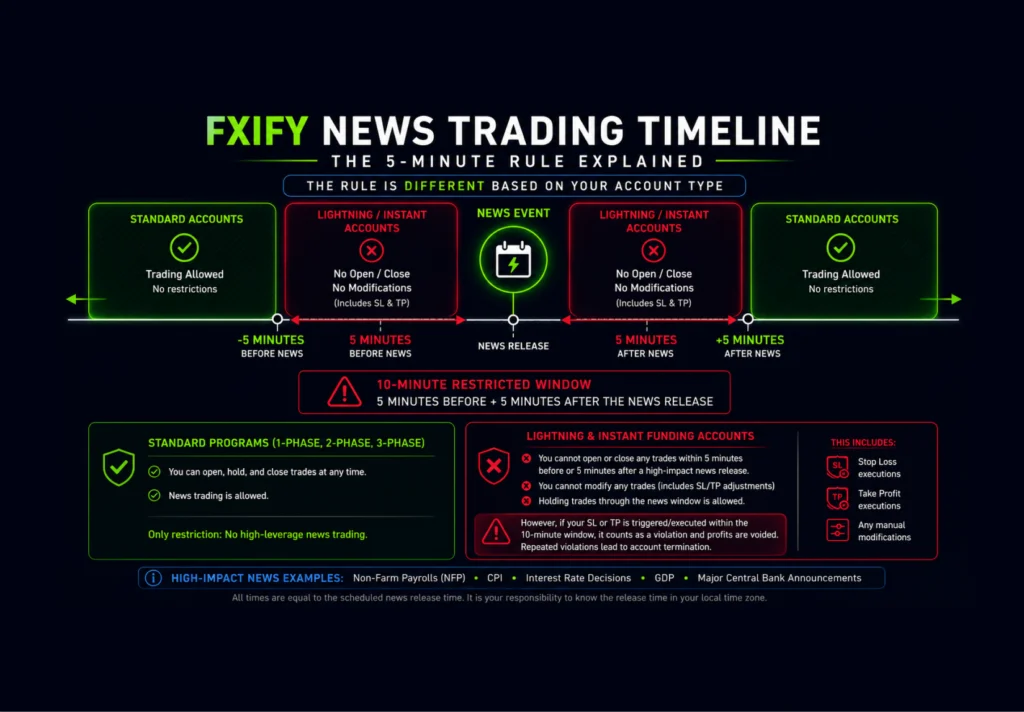
Any profits generated from trades opened during the restricted window are voided and will not count toward your phase target. Repeated violations lead to account termination.
Practical News Trading System for Standard Accounts
Since standard programs give you full execution freedom around news, here is a compliant approach that works consistently:
Step 1 — Pre-news: Identify key levels where price is likely to accelerate on a beat or miss. Note these on your chart.
Step 2 — Set pending orders: Place a buy stop above the nearest resistance and a sell stop below the nearest support. These trigger automatically if the news moves the market to your level; there’s no manual chasing of the spike.
Step 3 — Post-news: Once in profit by 15+ pips, trail your stop to breakeven. News momentum on forex pairs typically lasts one to three candles before a partial reversion.
Step 4 — Avoid: Manually entering trades on the actual release candle. Slippage during high-impact events inside a prop firm environment is significant, and the difference between your intended entry and your actual fill can skew the risk-reward materially.
Bookmark the Forex Trading Journals economic calendar to track every red-folder event before your trading session begins.
FXIFY EA and Copy Trading: How to Use Them Compliantly
Automated trading can be a powerful component of an FXIFY trading strategy, and FXIFY’s permissive stance on EAs is one of its strongest differentiators, but the rules have specific edges that catch traders off guard.
Expert Advisors (EAs)
EAs are permitted on the 1-Phase, 2-Phase, and 3-Phase challenges on MT4 and MT5. They are not permitted on Lightning or Instant Funding accounts, and they are restricted on DXTrade regardless of challenge type.
Running an EA through an FXIFY evaluation requires passing four compliance checkpoints:
No HFT logic. High-frequency strategies that exploit latency or generate hundreds of orders per session are explicitly banned across all accounts, EA or manual.
No martingale or grid scaling. EAs that increase position sizes to recover from losses, whether through classic martingale doubling or grid layers, are among the most common triggers for account reviews. FXIFY’s risk team identifies these patterns reliably.
No reverse or group hedging. Running the same EA on multiple FXIFY accounts simultaneously with opposing positions constitutes group hedging, a direct violation.
Consistent lot sizing. EAs that dynamically scale lot sizes based on volatility or drawdown recovery, even outside of martingale logic, attract scrutiny if the variation is large session-to-session.
The compliant EA profile for FXIFY is a trend-following system on H1 or H4 timeframes with fixed fractional position sizing, defined session filters (no trading outside London and New York opens), and a built-in daily loss limit that mirrors the account’s rule. A well-coded EA that respects the same constraints you would apply manually is far lower risk than any marketplace EA designed purely to maximise retail account returns.
Copy Trading Rules
FXIFY’s copy trading policy has three distinct scenarios:
Outbound (FXIFY → external): Fully permitted. You can copy your FXIFY account trades to any external account without restriction.
Inbound (your own account → FXIFY): Permitted, but you must first submit a full MT4/MT5 trading statement in HTML format (minimum one month of history) to FXIFY’s support team before you begin copying. This is not optional, start copying without it and you risk a violation.
Third-party signals (any signal provider → FXIFY): Strictly prohibited. If FXIFY’s risk team identifies that your trade entries, lot sizes, and execution timestamps match another account’s trading pattern, it constitutes herd trading or collusion, one of the most serious violations in their rulebook. Consequences include immediate account termination without refund.
The HTML statement requirement exists for a legitimate reason: FXIFY is verifying that the strategy being copied has a real, documented track record and that you are the authentic master account holder. Submit it proactively the moment you decide to use copy trading. Do not attempt to backfill it after the fact.
Swing Trading vs Scalping on FXIFY: Which Suits the Rules Better?
This is the most common question from traders who are deciding between FXIFY’s challenge types: which trading style makes for a better FXIFY trading strategy, swing or scalp? The answer is genuinely account-dependent rather than style-dependent.
Why Swing Trading Works Well on FXIFY
Several structural features of FXIFY’s standard programs actively favour swing traders:
No minimum time limits on standard evaluations. There is no rule requiring you to be in the market daily. You can wait a week for a clean setup and face no penalty. The only program with a time limit is Lightning (7 calendar days), which is optional.
Weekend holding is permitted on all standard programs, 1-Phase, 2-Phase, and 3-Phase. Most prop firms ban this. FXIFY’s explicit permission gives position traders the ability to hold through Friday’s close without forced liquidation.
Lower trade frequency means lower daily limit exposure. A swing trader taking two to four trades per week carries far less daily limit risk than an intraday trader taking fifteen trades per session.
The 3-Phase static drawdown is structurally designed for swing traders. The floor never moves, multi-day holds are mechanically safe, and the lower 5% phase targets allow a patient, lower-frequency approach.
The one genuine risk for swing traders on trailing drawdown accounts (1-Phase, 2-Phase) is gap risk. Holding a position over a weekend or overnight on a trailing account means a gap open against you can hit your stop and simultaneously push the trailing floor closer to your equity. Always account for potential gap distance when sizing swing positions on trailing programs.
Why Scalping Requires Extra Discipline on FXIFY
Scalping is viable on FXIFY, but it imposes the most demanding risk management requirements of any approach:
Trailing drawdown accounts punish losing streaks without mercy. A scalper who strings together six consecutive small losses before lunch can consume the daily loss limit entirely, and that session is over regardless of what happens in the afternoon.
HFT is banned, which rules out true algorithmic scalping. Manual scalping with deliberate, structured entries is permitted. Tick scalping and any strategy that exploits price feed latency is not.
The 5-minute news restriction on Lightning and Instant Funding accounts is disproportionately restrictive for scalpers, whose highest-probability setups frequently coincide with news-driven volatility.
If scalping is your style, the 1-Phase or 2-Phase standard program (not Lightning) is the right vehicle. Restrict execution to the London–New York overlap (13:00–17:00 GMT), set a hard daily stop before the session starts, and cap your trade count at a defined number regardless of outcome.
The Honest Verdict
After running real money through FXIFY evaluations and funded accounts, the pattern I keep returning to is this: traders who fail FXIFY challenges almost never fail because their FXIFY trading strategy does not work. They fail because it was not built for the specific account they chose.
The rules are not the obstacle. The rules are the design specification. Your FXIFY trading strategy is your trading method refactored to operate within defined drawdown types, daily loss limits, news windows, EA restrictions, and position sizing constraints. That refactoring is not optional. It is the entire exercise.
FXIFY is a genuinely good prop firm for strategy-flexible traders, with multiple platform choices, no time pressure on standard evaluations, strong profit splits, and the industry’s most transparent payout track record with over $33 million verified. Read our complete FXIFY prop firm review for the full picture on fees, payouts, and real trader experiences. Cross-reference the FXIFY drawdown rules breakdown before you buy. And use an FXIFY discount code to reduce your entry cost before you start.