
Hundreds of traders are reporting deposits that vanish mid-transfer and withdrawals stuck in an endless rejection loop and they’re all pointing fingers at the same broker. But is the XM scam label actually warranted, or is something more complex going on behind the scenes? We dug into the 2026 Trustpilot data, traced the payment infrastructure failures, and put together a step-by-step recovery guide for anyone with funds currently frozen. The truth is more nuanced and more actionable than the headlines suggest.
Is the XM Scam Real? Trader’s Investigation

Picture this, you’ve just had one of your best trading weeks. You log into XM, hit withdraw, and then… nothing. Days pass. You refresh. Still pending. You ping support, and get a chatbot asking for the same bank statement you already sent three times.
That’s not a hypothetical. That’s the exact experience hundreds of traders are describing right now. And it’s precisely why searches for “XM scam” have exploded in mid-2026.
So, is XM actually stealing your money? Or is something far more complicated going on? The answer isn’t a clean yes or no. And in some ways, what’s actually happening is more troubling than a straightforward scam, because it’s harder to fight.
Let’s get into it.
The “XM Scam” Search Surge: What’s Really Behind the Panic?
Not every broker accused of being an XM scam actually is one. But that doesn’t mean the traders raising the alarm are wrong to be furious, because in this case, they have very concrete reasons.
In early 2026, a flood of complaints from traders across South Asia, Southeast Asia, and parts of Africa began piling up on public forums and review platforms. These weren’t vague gripes from people who blew up their accounts and needed someone to blame. They were specific, documented, and repeatable, all pointing to two distinct failures:
- XM deposit not credited to trading accounts. Money was leaving traders’ bank accounts cleanly, but never arriving in their MT4/MT5 terminals. Not for days. Sometimes not for weeks.
- Withdrawals killed in a rejection loop. Traders with funded accounts were hitting sudden holds, automated compliance demands, and instructions to switch to crypto payouts, even when they originally deposited via standard bank transfer.
Now, here’s the real question: is XM deliberately holding onto your money? Or is something structurally broken in their payment system that they can’t, or won’t, acknowledge?
That answer is hiding inside how international brokers actually move regional currency. And most traders have no idea the mechanism even exists.
XM Trustpilot Reviews 2026: What the Data Actually Shows
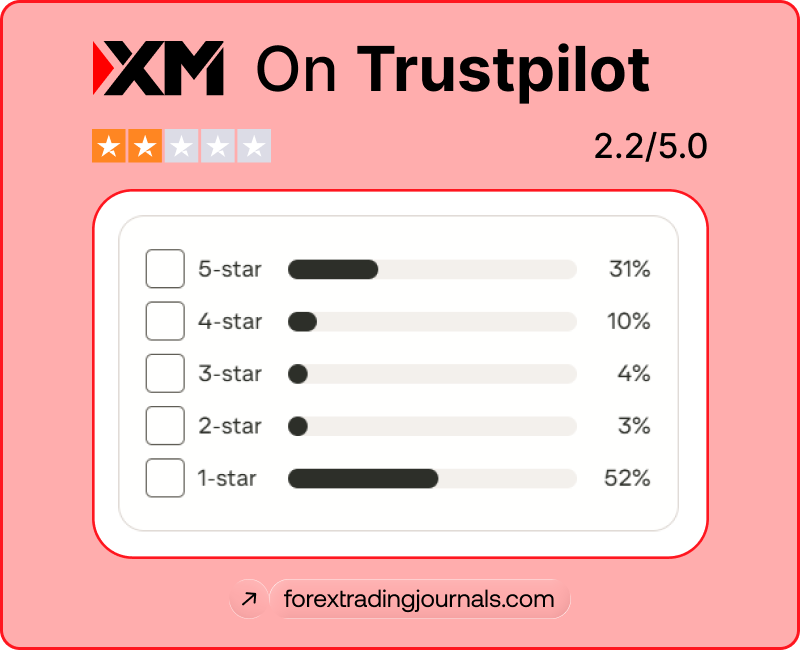
XM sits at a 2.2 out of 5 on Trustpilot heading into mid-2026, underwhelming on the surface, but the real story is in the 1-star tier. These aren’t generic trading loss complaints. The level of specific detail in the negative XM Trustpilot reviews 2026 is what makes them analytically credible, and deeply concerning.
The XM Deposit Not Credited Problem
Verified traders across the board describe the same experience: they send funds via UPI, Google Pay, or local Indian banking processors, see the debit confirm instantly on their bank end, and then watch their XM terminal do absolutely nothing.
One trader deposited ₹29,000, bank-confirmed, and couldn’t extract a straight answer from XM support about its location. Another sent ₹8,000 on February 12, 2026. By February 23, XM support informed them there was “no timeframe” for returning the funds. Not “we’re looking into it.” Not “three to five days.” No timeframe at all. A third deposited ₹30,000 through an XM-approved processor named Rahiv Fashion Fusion, same wall of silence.
This is not a handful of isolated incidents. It’s a documented pattern of XM deposit not credited complaints that all trace back to the same broken link in XM’s payment chain. And that broken link is the thing nobody from XM is talking about publicly.
XM Withdrawal Issues: The Loop That Traps Your Profits
Now forget missing deposits for a moment. What about traders who already have money in their accounts, real profits, earned through real trades, who are now trying to get it out?
Those traders are hitting an entirely different wall. XM withdrawal issues at this level follow a predictable and maddening sequence: a request gets flagged, an automated message demands facial re-verification or re-submission of KYC documents already approved months ago, the trader complies, and the request gets rejected anyway.
In a growing number of cases, traders who deposited via fiat bank transfer are being instructed to withdraw exclusively through cryptocurrency. Most traders don’t realize what that instruction actually triggers. Switching your withdrawal channel away from your original deposit method fires off Anti-Money Laundering (AML) compliance flags automatically. The freeze that follows cannot be overridden by a front-line support agent, they simply don’t have that access.
One trader filed a withdrawal request on January 16, 2026, uploaded every document requested, and had received zero resolution, and zero substantive communication, by January 25. Another had $388.48 frozen since January 27 with no movement whatsoever.
And then there’s the support experience waiting for all of them.
The Support Infrastructure That’s Making XM Withdrawal Issues Worse
Dig through enough of these XM Trustpilot reviews 2026 and a brutal secondary pattern surfaces: XM’s customer support is structurally incapable of resolving the underlying payment problems even when they want to.
What traders actually receive: live chat loops that cycle through the same verification script. Email replies that are copy-pasted templates with no case-specific content. Escalation requests that disappear into silence. And, perhaps the most revealing detail, XM’s own public Trustpilot responses that respond to every complaint by asking the trader to “reply to the Find Reviewer request.”
Critical warning: When XM’s Trustpilot reply asks you to “reply to our Find Reviewer request,” that is a reputation management protocol designed to take the exchange off the public feed.
It is not a resolution mechanism. It does not recover your funds.
Keep reading, there’s a recovery sequence below that actually works.
So the chaos is visible. The complaints are real. Now let’s talk about why this is happening at scale, because the mechanism behind it changes exactly how you need to respond.
Regulated Broker, Broken Pipes: The Infrastructure Failure Behind the XM Scam Label
Here’s what most people writing about the XM scam narrative get completely wrong, and it’s the most important distinction in this entire piece.
XM is not some offshore ghost operation with a Telegram support line and a fake Cyprus address. They carry serious, multi-jurisdictional regulatory licenses:
- ASIC (Australia), Tier 1 global regulator
- CySEC (Cyprus), Tier 1, EU oversight
- DFSA (Dubai), Tier 2
- FSC (Belize), Offshore tier
- CMA (Kenya), Newly secured February 2026
Real exit scams don’t operate under ASIC and CySEC oversight. They don’t submit to regulatory audits. So if the XM scam label doesn’t fit the evidence, what is actually happening to traders’ money?
The Hidden Relay That’s Causing Delayed Broker Payments
When you deposit into XM from India, via UPI, net banking, or a local payment gateway, XM doesn’t process that transaction directly. They legally cannot. They hold no local Indian banking license. So instead, they route your payment through a third-party payment service provider (PSP): a regional fintech or payment processor that holds a domestic bank account, collects your INR, and forwards the converted funds onward to XM’s international clearing accounts.
It’s a three-leg relay: your bank → local PSP → XM’s clearing firm.
Under normal conditions, this relay is invisible and fast. You never know it’s there. But the moment that regional PSP runs into trouble, a compliance freeze from the Reserve Bank of India, an AML audit trigger, a license suspension, or a simple liquidity crunch, your capital gets stranded in the middle leg. It’s left your bank. It hasn’t reached XM. It’s sitting in a frozen intermediary account that XM contracted but cannot unilaterally access.
That is the precise mechanism generating these delayed broker payments. It’s not a vault. It’s not fraud. It’s a frozen relay account that nobody seems authorized to unfreeze on any reasonable timeline.
The named processors appearing in recent complaints, including third-party gateways like Rahiv Fashion Fusion, point strongly to one or more regional PSP partners currently operating under compliance stress.
The hard truth about the XM scam debate: Fraud is intentional. Infrastructure failure is operational. Both scenarios leave your money inaccessible. But only one of them has a legitimate, documented recovery pathway, and knowing which one you’re dealing with determines exactly how aggressively you should escalate.
The good news is there are concrete steps. And they work far better than anything XM’s support team will volunteer.
Your Step-by-Step Recovery Playbook for XM Withdrawal Issues (Don’t Skip Step 3)
If your funds are stuck right now, whether it’s an XM deposit not credited or an XM withdrawal stuck in pending, here is the sequence that gives you the best recovery odds while building a paper trail strong enough for regulatory escalation.
Step 1: Get Authoritative Bank Documentation
Don’t rely on an app screenshot. Go to your bank directly and obtain an official statement showing the debit transaction with the full UTR number (for UPI/NEFT transfers) or ARN number (for card payments). These reference identifiers are the backbone of every payment dispute. Without them, your complaint has no teeth.
Step 2: Screenshot Everything Inside XM’s Member Area
Log in, navigate to your transaction history, and capture the pending deposit or withdrawal status screen, with the exact server timestamp visible in frame. Regulatory bodies care about server timestamps, not what your phone clock says.
Step 3: Bypass Front-Line Support Entirely
This is the step most affected traders skip. Stop using live chat. Send a direct email to [email protected] with this subject line:
“Formal Escalation, Unresolved [Deposit/Withdrawal], Account [Your ID], [Date]”
Use this template as your email body:
Escalation Letter
I am formally escalating an unresolved [deposit/withdrawal] matter not resolved through standard support channels. My XM account number is [XXXX]. The transaction was initiated on [DATE] for [AMOUNT] via [PAYMENT METHOD]. The UTR/ARN reference is [REFERENCE]. I have attached an official bank statement confirming the debit alongside timestamped screenshots from my XM Member's Area. I require written confirmation of current status and a specific resolution timeline within 5 business days. If unresolved within that period, I will file formal complaints with [ASIC / CySEC / relevant regulator] and my national financial ombudsman.
Step 4: File a Regulatory Complaint Simultaneously, Not After
Don’t wait for XM’s internal process to run its course before escalating. File in parallel with:
- CySEC (EU entity accounts): cysec.gov.cy
- ASIC (Australian entity accounts): asic.gov.au/complaints
- Your national central bank or financial ombudsman for PSP-layer disputes
A live regulatory complaint transforms your case from a support ticket into a compliance liability. The urgency calculus inside XM’s team shifts overnight.
The ForexTradingJournals Verdict: Not a Scam, But Still a Serious Problem
After working through all the evidence, here’s our editorial position, plainly stated.
The XM scam label, in its most literal sense, a broker deliberately stealing client funds, does not fit the documented evidence. The regulatory structure is real. What’s real alongside it is a severe, ongoing payment infrastructure failure generating widespread XM withdrawal issues and XM deposit not credited complaints that the company has not adequately resolved or publicly explained.
Both things are true at once. And the second one matters enormously to your money.
A broker that cannot guarantee you can access your own funds on demand, for any reason, carries counterparty risk that most traders are completely unaware they’re holding. Regulatory licenses don’t cover delayed broker payments. They don’t unfreeze PSP accounts. They don’t compensate you for the trades you couldn’t execute while your capital was stuck in a relay.
Our recommendation is direct: Until XM publicly acknowledges and resolves the regional PSP failures driving these complaints, traders in India, Brazil, and Southeast Asia should significantly reduce their capital exposure on this platform. Test with a small withdrawal before committing meaningful funds, full stop.
The One Thing That Could Actually Save You in a Dispute
Here’s what we’ve watched play out across broker dispute cases repeatedly: the traders who successfully recover disputed funds are almost never the loudest ones. They’re the most documented ones.
Financial ombudsmen investigating delayed broker payments and XM withdrawal issues need a precise, exportable record. A folder of phone screenshots doesn’t meet that standard. A structured log that shows exactly when you initiated a withdrawal, what the dashboard displayed, and how many days passed without movement, that’s what moves regulators to act.
The traders most likely to recover their money are the ones who documented everything before the dispute started, not after the panic set in.
Whether you continue trading with XM, reduce your exposure, or move to a platform with cleaner payment infrastructure, document every transaction with the discipline of someone who might need to prove their case in a regulatory hearing. Because in the current environment, that documentation may be the most valuable asset in your trading operation
Disclaimer: This article is investigative and editorial commentary.
It does not constitute financial or legal advice.
All complaint data referenced is sourced from publicly available Trustpilot reviews and regulatory disclosures as of May 2026.
Independently verify current platform conditions before making deposit or withdrawal decisions.


Reviews, Ratings, Learning and more